
T70x Engine Test Set
Presents engine, rotor, and fuel system condition from sensor to indication for H-60 / S-70i Black Hawk.
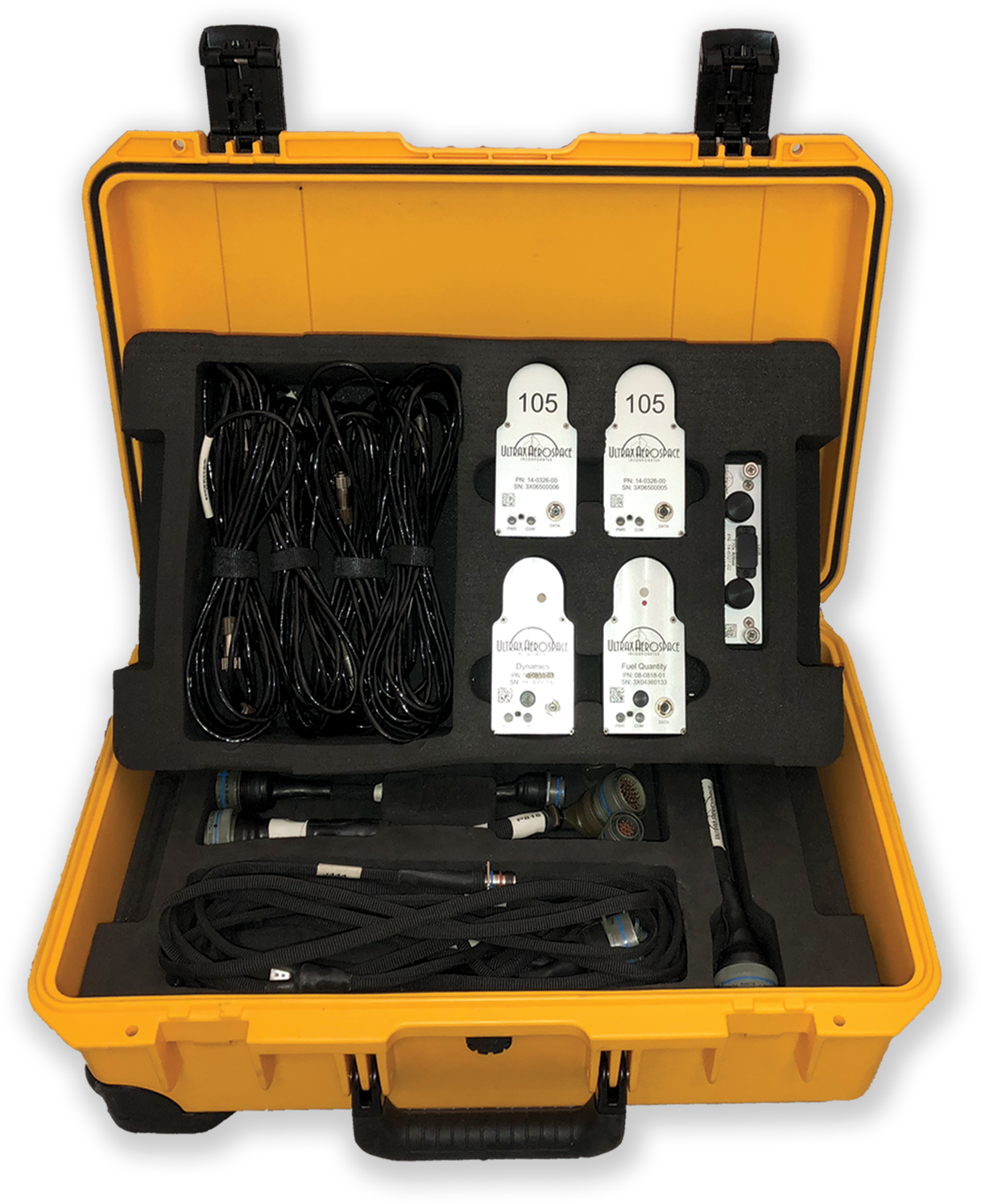
The T70x Engine Test Set, used with the UxValidator™ Series II, presents engine, rotor, and fuel system condition from sensor to indication so maintainers can listen for what the aircraft is showing, know operational status instantly, and act accurately.
T70x is one variant within the broader Engine Indications to Cockpit family. The S-70i/M Engine Indications Test Set and Navy / Coast Guard CSIE configurations apply the same firewall-forward logic in their own service environments.
This configuration operates in conjunction with the UxValidator Series II platform and is not a standalone solution.
The pods connect to the aircraft harnesses at sensor connection locations to drive signal emulations and indications to the live cockpit, reducing set-up time and the additional maintenance that a run-up cycle would otherwise require. The aircraft believes the Pod is the engine and the BrainPak is the pilot. System status reads out through the UxValidator user interface: check boxes, fields, and adjustable outputs. The included manual supplement leads the maintainer through each test with system validation criteria.
- Listen: disciplined observation of engine indication behavior across the signal path
- Know: preserves comparable context across runs and maintenance events
Firewall-anchored vs DCU-anchored indication evaluation
ULTRAX intentionally operates firewall-forward—not as a hardware constraint, but as a sustainment strategy. The firewall represents the boundary where ambiguity first enters engine–airframe decision-making, making it the most stable and informative place to anchor indication evaluation.
Both T70x and EICAS configurations support cockpit-facing indication evaluation. The distinction is not what they display—it is where the indication path is anchored, and what that implies for long-term stability, coverage, and problem isolation.
The T70x configuration anchors at the engine firewall, a durable boundary point that remains relevant even as downstream avionics evolve. By observing indications from this location, maintainers can separate the troubleshooting domain early—distinguishing engine-related behavior from airframe-related behavior before ambiguity escalates.
EICAS configurations typically connect at the DCU. That anchor point is more sensitive to future DCU changes, may be harder to access in practice, and does not cover the distance between the firewall and the DCU—leaving additional indication path unobserved when ambiguity appears.
By reducing ambiguity before a removal decision is forced, firewall-anchored evaluation helps prevent short-term availability losses that can feel like obsolescence—especially in limited-size fleets where a single precautionary swap can ground the mission.
| Dimension | T70x configuration Engine firewall connection |
EICAS configuration DCU connection |
|---|---|---|
| Primary connection point | Engine firewall | DCU |
| Stability over time | Durable anchor point; less sensitive to avionics evolution, including DCU changes | Sensitive to DCU revisions and avionics changes |
| Problem-domain isolation | Separates engine-side domains from airframe-side domains, allowing faster isolation | Couples troubleshooting to the DCU domain, making isolation less direct |
| Coverage of indication path | Covers the full path from firewall to cockpit | Covers DCU-to-cockpit; does not cover the firewall-to-DCU segment |
| Setup practicality | Firewall access is generally straightforward and repeatable | May require awkward access depending on aircraft configuration |
| Operational implication | Reduces ambiguity by bounding the troubleshooting area early | Can leave part of the indication path unobserved, requiring additional troubleshooting |
Both approaches reveal indications at the cockpit. The distinction is not visibility, but how much of the system is observable, how early ambiguity can be bounded, and how resilient the configuration is as avionics architectures evolve.
- Isolates engine from airframe at the firewall
- Isolates sensor from wire at transmission and fuel signal conditioner
- Emulates full specification range, not only operational indications
- Eliminates the need to run the engine to generate signal
- Emulates weight-off-wheels test flight in the hangar — no runway, no rotor turn
- H-60A/L/V — T70x engine indication domains (configuration-dependent)
- HH-60W — T70x engine test set configuration
- S-70i/M — engine indications configuration
- 17-0518-00 — T70x Engine Test Set (H-60A/L/V)
- 18-1130-00 — T70x Engine Test Set (HH-60W)
- 18-2120-00 — S-70i/M Engine Indications Test Set
As additional engine-indications-to-cockpit configurations are introduced, this family expands on the same UxValidator foundation alongside S-70i/M and Navy / Coast Guard CSIE variants—increasing coverage without replacing the platform or resetting the decision environment.
| Service | Part Number | Applies To | NIIN | Manuals | Service Pack Rev |
|---|---|---|---|---|---|
| US Army | 17-0518-00 | H-60A/L/V | 01-695-0225 | T70x Engine Test Set Maintenance Manual, PN 17-0828-01, Rev 5 | 5 |
| US Air Force | 18-1130-00 | HH-60W | 01-708-6066 | T70x Engine Test Set Maintenance Manual, PN 18-1130-40, Rev 6 | 2 |
| S-70M/i | 18-2120-00 | S-70i/M | T70x Engine Test Set Maintenance Manual, PN 18-2120-30, Rev 1 | 3 |
*Not a calibrated item; no firmware required.